
It’s not about running fast. It’s about knowing what truly matters when everything speeds up.
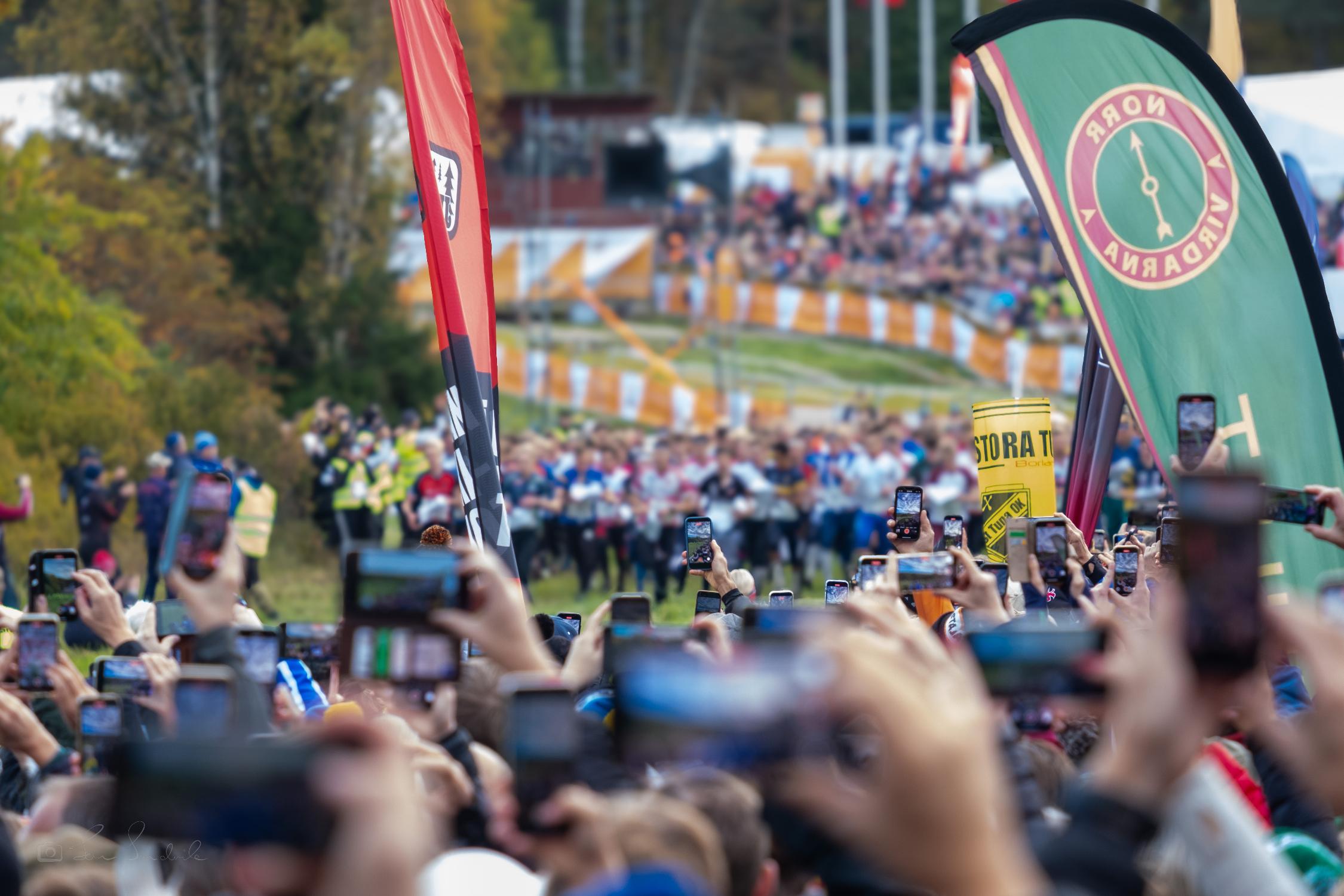
One small mistake can turn a perfect race into a lesson about fear, focus, and decision-making — even for the very best.
This year 25-manna took place in a beautiful Upplands Väsby, north from Stockholm. Fast terrain with mostly flat contours, detailed areas alternating with vague zones, and just a bit of zones with reduced visibility. It was an enjoyable terrain — perfect for running at maximum speed.
A beautiful day of golden autumn turned into sadness for several very strong teams when their runners saw three horrible letters on the split after the readout: DSQ. In my experience, one of the most nervous moments is waiting at the readout to see if all the punches were registered — but being sent to the red exit at a relay, especially a 25-person team relay, is a special kind of nightmare. This year it happened even to elite runners, and it made me think a lot about the fight, about how we react and make decisions, and why such a mistake can happen even to top athletes. I also recalled my own past – because once I failed to avoid this mistake too.
But back to 25-manna.
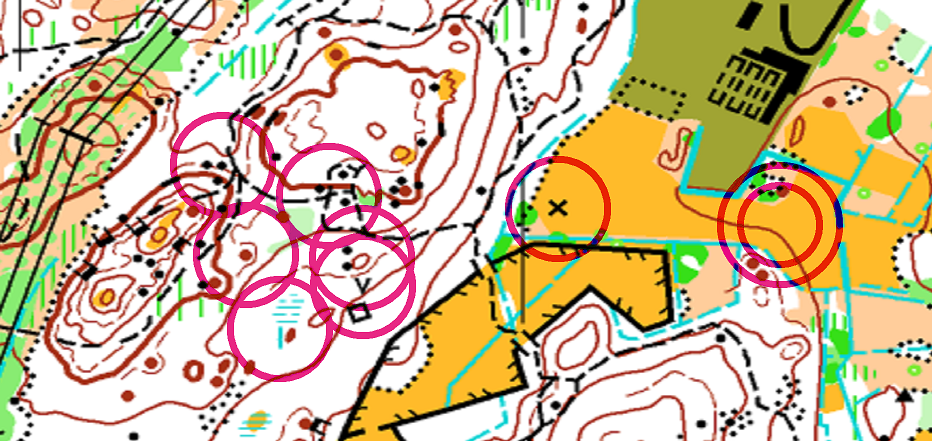
It’s obvious that the two most eastern controls (the black pit and the little hill) are very close to each other, and maybe even within visibility.
We could discuss endlessly whether the rules for minimum distances between controls should exist or not, and how many meters should be between the controls placed on different objects and why — but it’s not what interests me most here.
As an athlete, I was always curious about what exactly happens when someone forgets to do something really important — like checking codes or keeping the correct order — and ends up punching the wrong control. To be honest, I was sure I would never make that mistake myself. Well, if you go too high thinking about yourself, the awakening will be rude (a moment of self-irony). In 2018, at the World Cup in Østfold, I disqualified my team while fighting for the top-3 positions, and the pain from that day still feels fresh.
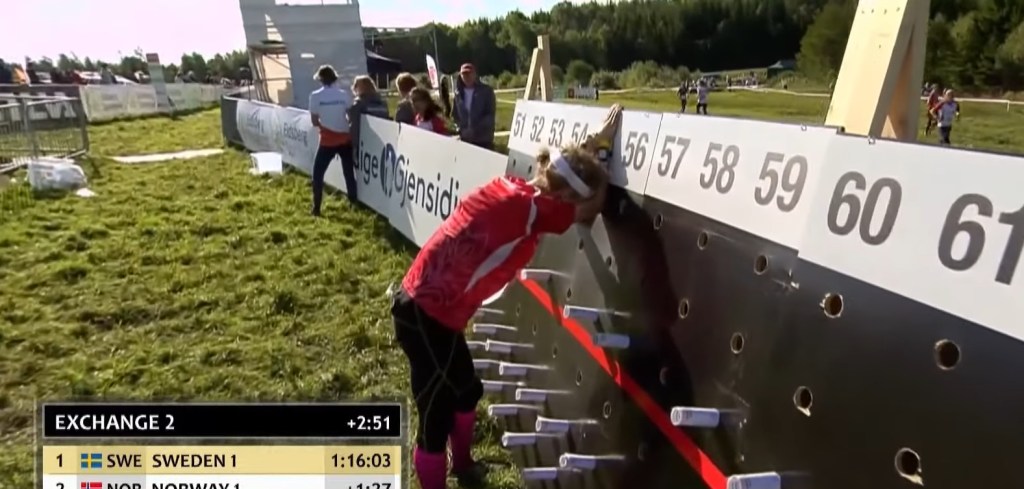
Now, as a coach, I’m even more interested in understanding the mechanisms behind such moments, because I want to teach athletes in a way that helps them avoid this sad experience — or maybe I’ll need to admit it’s impossible to avoid? What do you think?
One of the challenges of 25-manna is usually (and this year it was especially tricky near the finish) the forking in split legs, but also simply the huge number of controls in the terrain. Since the Swedish Federation removed the rule about minimum distance between controls, the tension has increased: now flags can be almost within sight of each other. Usually, we expect that a child or a less experienced runner can forget to check codes in such a stressful situation, but even very experienced athletes make this mistake. In that case it’s not about orienteering technique — it’s about psychology. So where is that border between doing things right and making a fatal error? And what makes a runner cross it?
Back to 2018. That day at the World Cup relay, I started on the second leg, receiving the relay in the leading group. The previous days had been really tough: long, and middle qualification plus a chasing start in heavy Halden terrain. I wasn’t ready for such conditions — high heather and soft thick moss, rough ground at areas of freshly cut forest — and I felt exhausted already at the start. At the same time, I was incredibly motivated to perform well. I clenched my teeth and tried to stay with the group. Almost immediately the forking spread us; I lost contact with the map for a moment in a vague area, panicked about losing time, made a small, nervous zigzag — and found the flag.
I checked the code. I clearly remember looking at the number on the flag and then at the control description on the map. Something felt weird — the number looked more like control 2 than control 1 — but I didn’t take time to re-check. I wanted to believe it was fine. I hadn’t made a big navigational mistake during the leg, the other runners were close, and all I wanted was to stay with the group. It took a huge effort to keep up all the way to the finish, but in the end, the relay finished in DSQ — thanks to me.
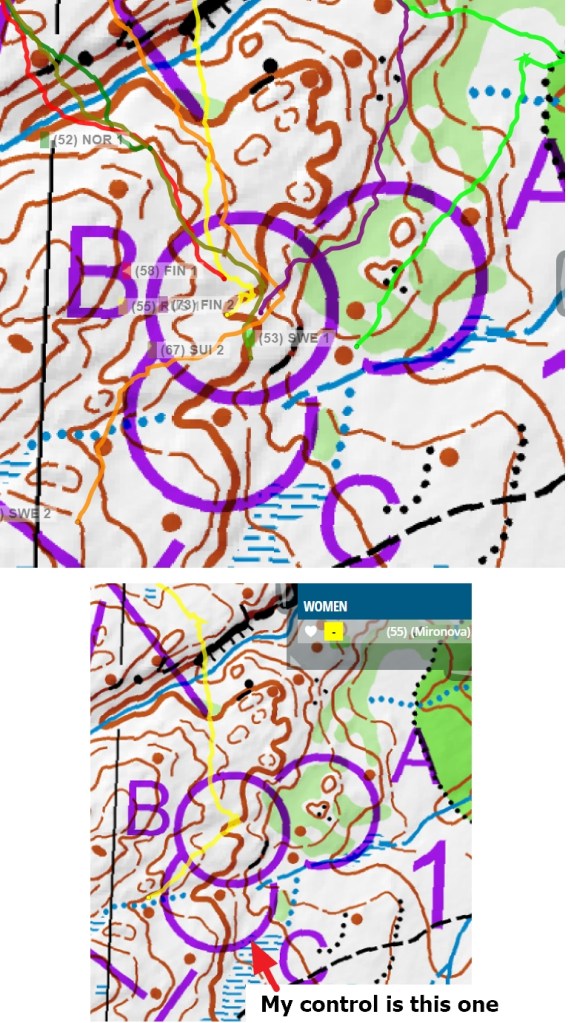
Afterwards, replaying that moment again and again, I couldn’t find peace. It was true — I had checked the code, felt something was wrong, and still didn’t recheck. Why? – I asked myself again and again.
Later it became clear. From the very start my body and mind were tired, but I was trapped by fear — fear of losing speed, losing the group, losing the relay. I knew it was hard to prove my shape and earn a place in the first team, so I couldn’t show any weakness. In those moments of hesitation, I always prioritized staying with the group, maintaining speed and trying to get the result I wanted. With that focus it was easy to forget the basics: I forgot how to begin the race and build good enough contact with the map, and, in the end, I forgot the most fundamental rule of relays — to check the codes properly.
“So should I stop wanting to show my best and forget about the leading group?” you might ask. Not at all. The result comes from a combination of every runner’s decisions and actions during the race — and each of them must be done in the right moment. If it was time to check the code, I had to check the code, even at the cost of losing the group. Success in orienteering depends on understanding what truly affects the result, and in what order. When we mix up priorities, the consequences become unpredictable — in my case, it led to DSQ.
The edge between doing correctly and doing a fatal error is very thin
The edge between doing correctly and making a fatal error is very thin.
During a race, an orienteer handles a huge amount of information and decisions, doing several things at once — all under competition pressure. When the intensity rises, for example at the end of last leg of a relay, it becomes impossible to consciously control every step. Many actions turn to be done automatically, unconsciously.
But the problem with automatic, reflex decisions is that they’re driven by deep inner motivations — by what really matters to us deep down. In extreme stress, these motivations overtake any conscious “must do.” In my case in 2018, my fundamental drive was fear of losing; in reality, it became the desire to stay with the group and not fall behind. And as soon as I got stressed, that unconscious priority took over — and I stepped onto thin ice.
It is not enough just to know how to orienteer and “simply remember one important thing” during the race
That experience taught me that it’s not enough just to know how to orienteer and “simply remember one important thing.” Under pressure, we appear to be acting according to the systems we’ve built — and if our deep priorities aren’t aligned with right actions, mistakes are almost inevitable.
To perform at the elite level, we need to build a system of priorities strong enough to guide us even when we’re on autopilot. That’s what I call fully systemic orienteering: when even your unconscious part plays for you, not against you.
As athletes rise higher in their careers, they face more and more moments of extreme tension where every wrong decision costs more. That’s why, as a coach, I see how sooner or later every discussion leads to the psychological side of orienteering. It connects deeply with technique and with the physical side — but under it there is always the structure of our deep priorities, the real engine of our decisions.
Building this base might be what allows athletes to act correctly in decisive moments — and reach the next level in their careers.
 Svetlana Mironova | Elite Orienteering Technique
Leave a comment